“Whenever you are about to find fault with someone, ask yourself the following question: What fault of mine most nearly resembles the one I am about to criticise?”
Marcus Aurelius Roman Stoic Philosopher, 121 – 180
Tag: Wellness
Good Morning! 📙
“Humans have come into being for the sake of each other, so either teach them, or learn to bear them.”
Marcus Aurelius Roman Stoic Philosopher, 121 – 180
Giving yourself a mental break
Give yourself a break; Is it just me or is it becoming normal to be laying in bed and still be exhausted; having a lot to do but not having the energy to do it? Like me, are you struggling to sustain a healthy period of sleep, is time going by quickly, are you struggling to recall information? Okay, I think we need a mental break. In this blog, I will be giving you pointers that will be practically helpful in the short run.
Releasing a frantic mind
If you are like me, you will punish yourself by filling up your mind with thoughts unnecessarily and aggressively when you could be okay with just simply not having them. It’s hard telling yourself to rest when you are so used to running, and it’s hard telling yourself to rest when you feel like you are not deserving of it but if you are reading this, your intuition is probably telling you it’s time to take a mental break.
If you know that you want to pause your frantic mind, then you need to find a safe space and practice stillness. A safe space can be anything, anywhere, as long as it’s a space that you have chosen to be the location that you know gives you a comforted feeling of being alone. Some of my safe spaces in the past have been, the roof of a car park, an empty meeting room that no one goes to at a particular time, my couch and one I have created in my mind when I meditate. I
Journal
Journalling, is another well-known activity for health and wellness and there are two types:
- Expressive writing: journalling your innermost feelings and thoughts; focusing on the experience.
- Gratitude journaling: focusing on the positive aspects of life by capturing situations, events, and interactions for which you are grateful.
The Benefits of Journalling run far and wide and I don’t want to bore you with endless facts, so here are a few:
- Reducing anxiety
- Breaking away from a nonstop cycle of obsessive thinking and brooding
- Improving the awareness and perception of events
- Regulating emotions
- Encouraging awareness
- Boosting physical health
You do not have to restrict yourself to traditional journalling (writing in a notebook), you can also type in a digital notepad or voice record on your phone, whatever works for you. The most important point is that you feel safe and comfortable doing the activity
Going out
Goodness, gracious, going outside. So simple yet so hard, you know it is just there, but you just cannot get yourself to do it. If what I am thinking, and feeling is weighing heavy I write it down and sometimes take it 2 more steps further; break down actions I may or ideally take regarding it and then I dare myself to put on some shoes; step outside and breathe. Commit to a 5-minute mindful stroll, leave your phone behind if you are willing; and then pay attention to the small things that are around you. Doing this alongside sitting down for 5 minutes in silence can do wonders.
Give yourself a Social Media break
I mean, what is there to say; for most people, social media is a part of our lifestyle and we’re constantly taking in information that ends up freely wandering in our subconscious. It can be draining and can have you floating away from the reality that is now. Let’s challenge each other to stay away from it until the next morning and see how we feel 🙂
Surprise yourself! naturally
Balance out the stuffiness of your mind by giving yourself a natural dose of happiness chemicals.
Dopamine (Reward Chemical) 🥇: Enables motivation, learning and pleasure.
How you could release it: Complete a task, Celebrate a small win (I play the easiest level of chess and it sincerely lights up my day again)
Oxytocin (The Love Hormone) ❤: Motivates you to build and sustain relationships (it’s simply satisfying)
How I release it: Giving a sincere compliment, Hugging a family member,
Advertisements
Serotonin (Mood Stabilizer) 🧘♂️: Helps with self-acceptance.
How I release it: Meditation, Sun Exposure, walking in nature
Endorphin (Painkiller) 💊: A response to pain and stress that temporarily alleviates from mental and physical pain
How you could release it: watch a comedy, Essential Oils (Lavender is a natural go-to), Exercise
None of these stick in the long run and they do have their shadow effects; with that, it’s all about maintaining a balance a lot of the time when our brain is ‘exhausted’ it’s usually due to a consistency of something bad or even good. Almost like a wheel of fortune, a mental break isn’t just referring to stress, it’s referring to change and it’s referring to balance. I hope you can treat your mind nicely today, forced relaxation or positivity is also harsh on your mind and are typically counterproductive, follow your inner knowing to unbind the knots in your mind. If you have any suggestions please do comment below.
If you still need a little more or just more of an extensive guide if you know that you have constantly found yourself in a cycle of mental exhaustion I would love to recommend one particular book that gives you a sincere and practical guide to mindfulness:
I sincerely recommend their book: Mindfulness: Finding Peace in a frantic world. Their book provides a practical guide for practising mindfulness based on Mindfulness-based Cognitive Therapy (MBCT) and is suitable for people who don’t have a particular emotional or meant al disorder. This book really opened my eyes to help me understand why my brain was challenging me at an unhelpful time and gave me a beginner’s guide to put a stop to obsessive negative cycles.
I understand there are some who have it harder, I learnt that one of the co-authors of the book also wrote another edition called: The Mindful Way through Depression, this may hopefully validate your hardship but also give you the clarity that you may need to support you on your journey. Both books have been received positively, but if you have any other suggestions please share!
1.
2.
.
.

Take Notice: Mindfulness in Enclosed Spaces
Taking Notice! Mindfulness programmes are naturally encouraged in an open space, outside where the grass is green, and the birds are chirping but there are times when we don’t have the energy to go outside and in some cases, you may not be in a position to leave an enclosed space, so here is what I do to stay mindful; to reduce stress and attain a moment of calm within closed walls.
Mindfulness Meditation
I know very cliché, I can already hear the sighs; meditation is one of the most well-known activities for better well-being but has often been seen as a waste of time or a bit of a joke. However, mindful meditation during a frantic period or when you are feeling overwhelmed, helps you realise that thoughts come and go on their own accord like clouds and that in itself is empowering.

First, mindfulness meditation is slightly different from what we understand about ‘meditation’.
Concentrative meditation involves focusing on a specific thing while tuning out everything else around you this would be Hollywood’s interpretation of Meditation, which is for instance focusing on a mantra like ‘Oms’ or reciting an affirmation slowly.
Mindful Meditation is about awareness and accepting your environment.
The Benefits of Mediation:
- Anxiety, depression and irritability all decrease with regular sessions of meditation.
- Memory improves; reactions times are faster
- Mental and Physical stamina improves
- Creativity Increases
- Regular meditators enjoy better and more fulfilling relationships
Let’s try it now! so focus, breath in, and breathe out slowly. Doing this at a set time daily has proven to have long-term effects on reducing anxiety, and preventing depression and for those who already have depression, it can help with your transition out of it.
Okay so let’s practice:
*Ideally you will be in a quiet area but when there is noise don’t see it as a distraction, accept it

Step 1: Sit Erect
Step 2: Now, focus on the breath, focus on your inhale and your exhale steadily and keep this up (when your mind wanders, gently and slowly bring your attention back)
Step 3: Keep this up for 2 minutes
You will slowly get the hang of it and adjust how long you will want to meditate.
Clearing Myths about meditation:
Okay, about meditation; referencing the words of Mark Williams and Danny Penman:
- It’s not about becoming lazy, deadening your mind or accepting the unacceptable, it’s about providing greater clarity- spotting negative patterns and putting you back in control to make more considered decisions to change what needs to be changed
- There is no failure or success, it can be difficult but just trying is already a good step
- Patience and persistence are required but meditation liberates you from the pressure of time
I sincerely recommend their book: Mindfulness: Finding Peace in a frantic world. Their book provides a practical guide for practising mindfulness based on Mindfulness-based Cognitive Therapy (MBCT) and is suitable for people who don’t have a particular emotional or mental disorder. This book really opened my eyes when I was feeling overwhelmed and incapable of moving away from destructive emotions. A true beginner’s guide to putting a stop to obsessive negative cycles.
For those who may need more help one of the co-authors of mindfulness, co-wrote a book called: The Mindful Way through Depression. Both books have gotten positive feedback, you might want to check them out.
Advertisements
Diary Entries
Journalling, is another well-known activity for health and wellness and there are two types:
- Expressive writing: journalling your innermost feelings and thoughts; focusing on the experience.
- Gratitude journaling: focusing on the positive aspects of life by capturing situations, events, and interactions for which you are grateful.
The Benefits of Journalling run far and wide and I don’t want to bore you with endless facts, so here are a few:
- Reducing anxiety
- Breaking away from a nonstop cycle of obsessive thinking and brooding
- Improving the awareness and perception of events
- Regulating emotions
- Encouraging awareness
- Boosting physical health
You do not have to restrict yourself to traditional journalling (writing in a notebook), you can also type in a digital notepad or voice record on your phone, whatever works for you. The most important point is that you feel safe and comfortable doing the activity.
Privacy:
I had an old friend find my diary and just read a page out of my book before so I definitely recommend thinking of ways to make sure your diary logs remain private. Unless you’re leaving your thoughts to be passed down like Marcus Aurelius I would encourage you to maybe purchase a book with a padlock.
Open-up Your Senses
This builds a sense of awareness which is necessary when you numb yourself from the sometimes suffocating feeling of an enclosed space, it’s up to you to decide what you do with this feeling so that it is not prolonged (now that you have noticed).
- Sight: State 3 things you see around you that vary in distance
- Smell: What does your environment smell like (if you have an odour you should probably take a shower, it will make you feel better, trust me)
- Taste: Are you eating something? what does it taste like? (if your mouth is kind of bitter and you’re not eating, you should probably brush your teeth)
- Touch: Touch some fabric and then touch the skin on your face, notice the difference
- Sound: Concentrate and in your head (or out loud if you want) describe 3 things you hear around you
Opening up/ activating your senses is about grounding yourself in the moment- this is an exercise that is helpful when you are feeling overwhelmed.
Time Management Games/ Hobbies
Time management tasks are not supposed to make you feel rushed or competitive. The goal is to use your patience to focus on a particular task to achieve a desired outcome. Some of the main causes of stress are when your input doesn’t give you your aspired output, where the actual self is far from your ideal self. It’s the worst feeling ever 
Time management activities can help take some pressure off yourself mentally and physically and make you feel a sense of accomplishment when you’re feeling overwhelmed by negative emotions/moods. Some examples of some Time management tasks :
- Washing the dishes
- Jigsaw Puzzles: I prefer pictures that are not repetitive in pattern and shades of colour (I saw a jigsaw puzzle online and the image was a wave; imagine trying to differentiate between 2-3 shades of blue and some white pieces, figuring out which goes where for a 1000 piece puzzle! I cry)
- Chess: (If you already know how to play) a game that teaches you to have some pace and be mindful of your actions there are various free apps available.
- Knitting, Sewing or crafting e.g. paper cranes
- Colouring

If you have any more suggestions let me know; more variety makes it more interesting and less repetitive.
To sum up, there aren’t any chronological steps or regulations for mindfulness it’s all about you being at ease and being present; its as simple as taking a deep breath, just like that and for a second you feel a connection with yourself a connection that grounds you, making you feel in control. With enough consistency, you can feel your anxiety, stress and tension decrease as you set out to do other activities.
.
.
Take Notice: Mindfulness Outdoors
Take Notice- Mindfulness Outdoors
Take Notice! Putting mindfulness into practice every day can positively affect the brain patterns underlying day-to-day anxiety, stress, depression and irritability. When we are engaging with our stressors it can leave us feeling unpleasant and unsatisfied with ourselves, we might start thinking about our ideals and indulge ourselves in practices that quickly bring us gratification such as escapism, rather than showing gratitude for where we are right now and being ‘okay’ with it. Aspirations and pleasure are not at all bad, however, they can become unhelpful as they can put further pressure on us by negatively perceiving and challenging our current being. Here is what I do actively, to reduce tension, by staying present at the moment.
Walking without Music
Why do you listen to music when you are in transit? I knew I did so because I wanted to flush out the loud noise of my environment; everything was frantic without music and it just felt like it was adding to my stress. But, when you remove your earphones, after some time you begin to accept the noise, acknowledge your surroundings, and focus on what you’re doing. This mindfulness activity allowed me to ground myself in the reality that I am in, giving myself time to accept my emotions, acknowledge what my current thoughts are and narrow down my thinking and decision process.
Taking Pictures of the scenery
Do you ever associate a smell, a taste, or a location with a good memory? Well, photos allow me to do that but have the further benefit of becoming aware of my present.
I never bothered with photos in the past because everything always seemed so frantic in every moment I was in, so I didn’t think about taking a photo unless it was with friends. However, there came an instance when things started to quiet down, it was my birthday and I was outside sitting down with my friend on the edge of a lake. The sun was setting beautifully and my friend and I comfortably appreciated the beauty with awe, I took out my phone to capture the moment.
That picture is now a trigger to a node in my mind that allows me to reminisce on the past but more so replicate how I felt in my present reminding me to value the beauty of the present. It’s a stress reliever during difficult times and I don’t even need a high-class camera for it videos can also remind you to be grateful and value the ups and downs of life and just live in the moment.
Photography can encourage you to pause and take notice of what is going on around you. Here are a few photos that I took on days that I realised were quite important to me:
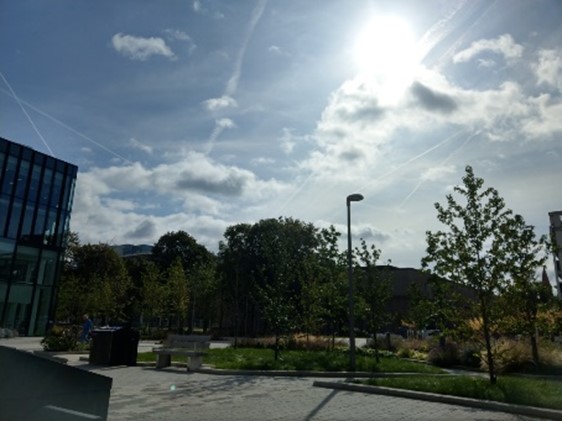

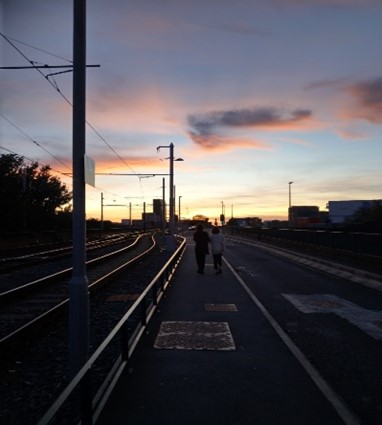
I am sure that the place where you live has its beauty, but you need to go outside your typical routine to see that.
Walking for the sake of Walking
Walking is the best hobby I have ever taken on (when it’s not raining). I walk to discover and explore new locations in my city but as of recently I have been feeling quite overwhelmed so rather than having a destination, I just walk for the sake of walking, no end goal, no time restraints, just comfortably but safely walking. I tend to self-reflect when I find a place to sit but as I am walking I allow my mind to stay clear; accepting what’s going on around me and seeing everything as part of my journey rather than a distraction during my journey.
Advertisements
Getting Lost
Maybe I should be more euphemistic, ‘Taking a detour’. Safety is of the utmost importance when doing this, I particularly look out for landmarks to get a rough assumption as to where I am and how far I am from my destination (of course, you can use google maps, but where’s the fun in that). I feel like there are two benefits to having a bit of a wander; one, being that exploring the area you live in and probably discovering new aspects of it that may benefit you.
Once I took a spontaneous stroll and saw some big lights flashing in an area not too far from me, so I walked there out of curiosity and guess what my introverted, broke, student-self found, an ASDA! More specifically a High street retail park (KFC, McDonald’s, Argos, and Pond stretcher all in one place, secluded from the busy streets of my university). The local stores around my student accommodation had a lot of students going there thus it was often crowded and had long queues. Making it so exhausting and uncomfortable to shop. Honestly, it was a dream come true, picture yourself listening to an alternative/indie playlist, walking through some awkward paths in the dark (don’t do this) and then as the song is reaching its climax, BOOM you discover something beautiful! for me that just happened to be ASDA.
The second benefit is the increase in my awareness going on a detour automatically makes you cautious as you tread on land that you don’t have much knowledge of. As you can guess being aware also means your being mindful. Subconsciously you start to simplify your thoughts and direct them to the reality of how close am I to my destination, what is on my left? What is on my Right? What is behind me and what is in front of me? And if you take on any of my tips you might see something pleasing to the eye and take a picture of it.
This rounds up the top 4 things I do to stay present and reduce tension.
.
.
 Ester's Eunoia